

Technology-Based Transformation of Greater Asia in the Age of Agentic AI
Implications Regionally and Globally – Featuring Insights from the 2026 Spring Global Immersion Course
The Greater Asia region is emerging as a global leader in the transition from a “digital first” to an “AI-first” future for consumers, enterprises and society. Across Greater China and Southeast Asia, organizations are increasingly deploying agentic AI —autonomous systems capable of reasoning, decision-making, and delegated action — as a core business capability. From the rise of AI-as-a-Service models to disruptive large language model offerings from innovators such as DeepSeek, companies throughout the region are redesigning products, operations, and customer experiences around intelligence as a foundational capability, signaling a broader shift from cloud-native to AI-native enterprises.
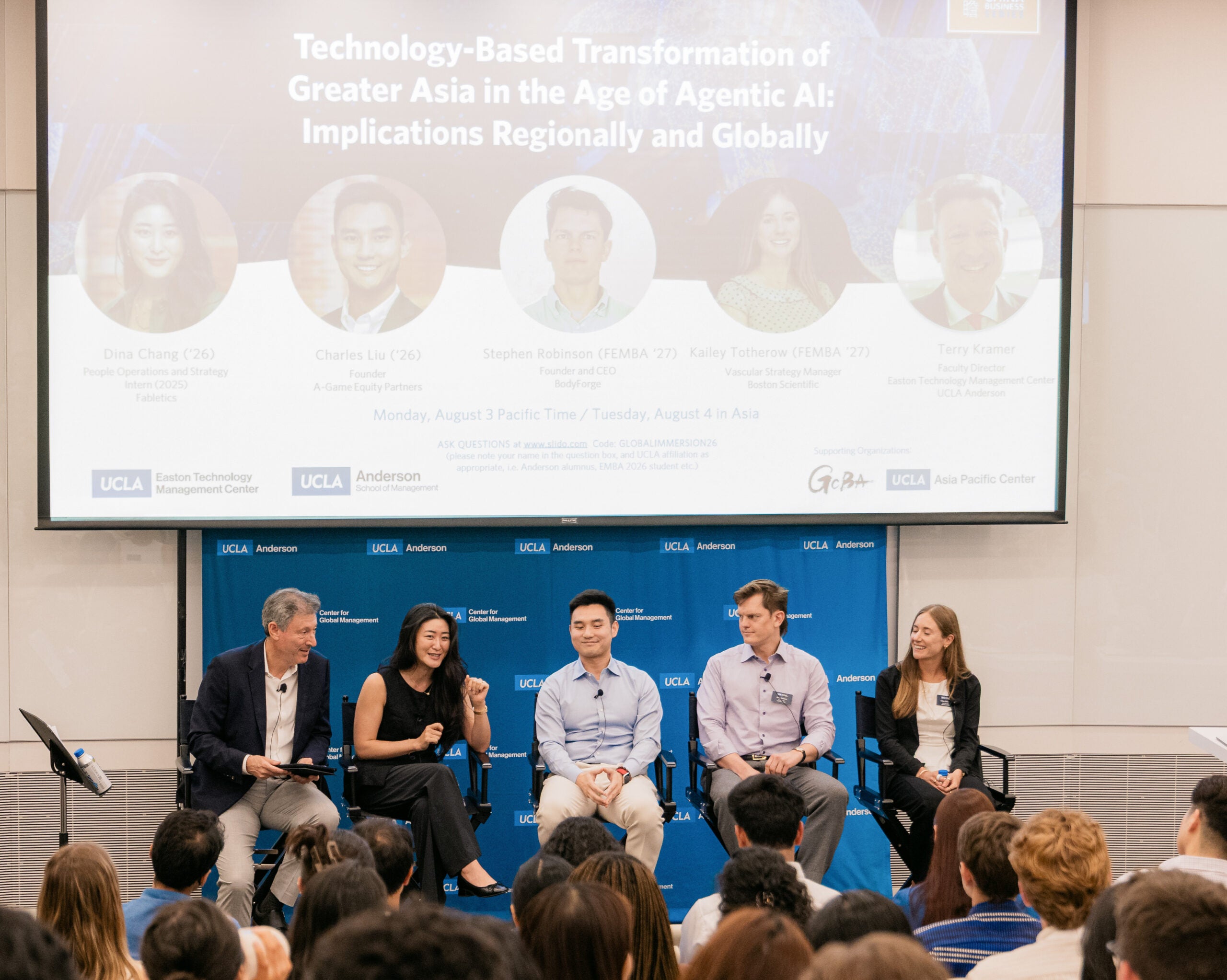
On August 3, the Center for Global Management (CGM) hosted its inaugural event of the 2026-27 academic year in collaboration with the Easton Technology Management Center. The evening began with a networking reception that brought together students, alumni, and many members of the incoming class before transitioning into a dynamic discussion moderated by Professor Terry Kramer, faculty director of the Easton Technology Management Center. The event, part of the Wilbur K. Woo Greater China Business Series, featured students and alumni who participated in CGM’s 2026 Spring Global Immersion Course focused on technology, innovation and AI across Shenzhen and Singapore. Drawing on firsthand experiences from two of the world’s most dynamic innovation hubs, panelists explored how emerging technologies are reshaping industries, institutions and leadership in the age of agentic AI.
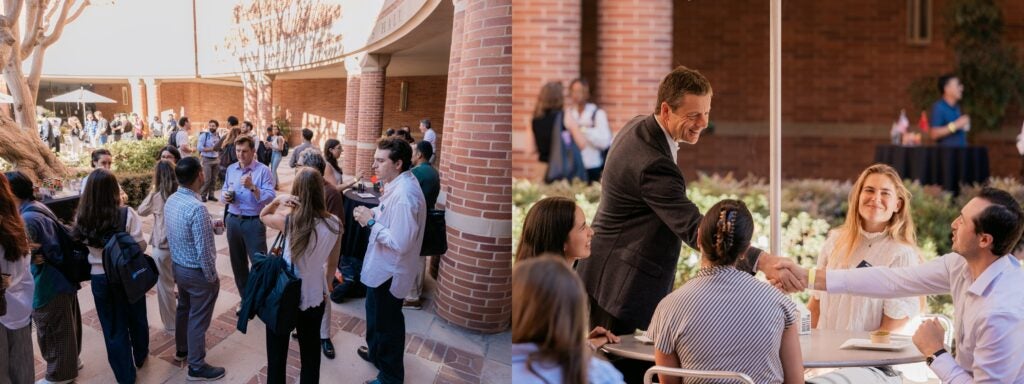
The program opened with welcome remarks from Lucy Allard Nelson (’06), executive director of the Center for Global Management, who highlighted CGM’s global immersion courses and their role in helping students develop a deeper understanding of international business, innovation ecosystems and contextual leadership. She thanked the Woo family for their longstanding support of the series, represented at the event by Michael Woo, and introduced UCLA Anderson Dean Gareth James and Professor Kramer. Dean James then delivered opening remarks, emphasizing the importance of a global perspective in management education and the value of understanding technology-driven transformation through direct engagement with international markets and business leaders as part of CGM’s Global Immersion experiential learning courses.
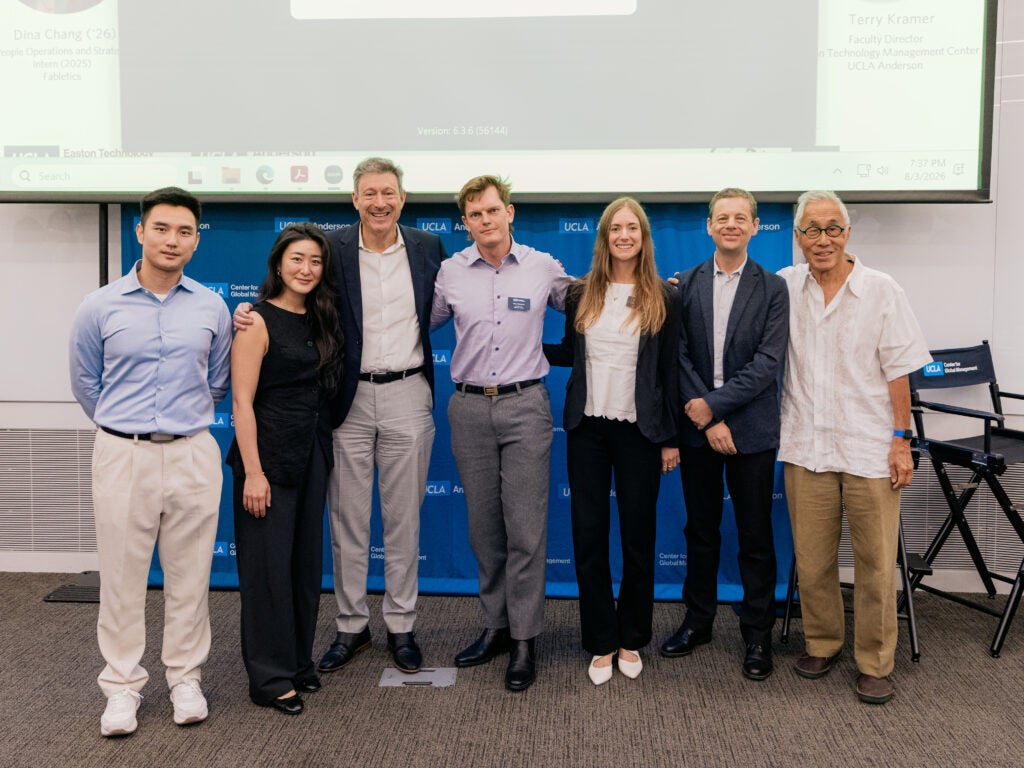
Professor Kramer provided an overview of the global immersion course and shared key observations from the program before transitioning into a moderated discussion with four student and alumni panelists: Dina Chang (’26), People Operations and Strategy Intern (2025), Fabletics; Charles (Changjin) Liu (’26), Founder, A-Game Equity Partners; Stephen Robinson (FEMBA ’27), Founder and Chief Executive Officer, BodyForge; and Kailey Totherow (FEMBA ’27), Vascular Strategy Manager, Boston Scientific. Through company visits, executive briefings and in-country discussions with organizations including Alibaba, ByteDance, BYD, Google, Grab, Meta, SHEIN, Temasek, Tencent, UBTECH Robotics, and emerging AI innovators, participants gained direct exposure to how Greater China and Southeast Asia are accelerating innovation through the convergence of talent, capital, policy and experimentation.
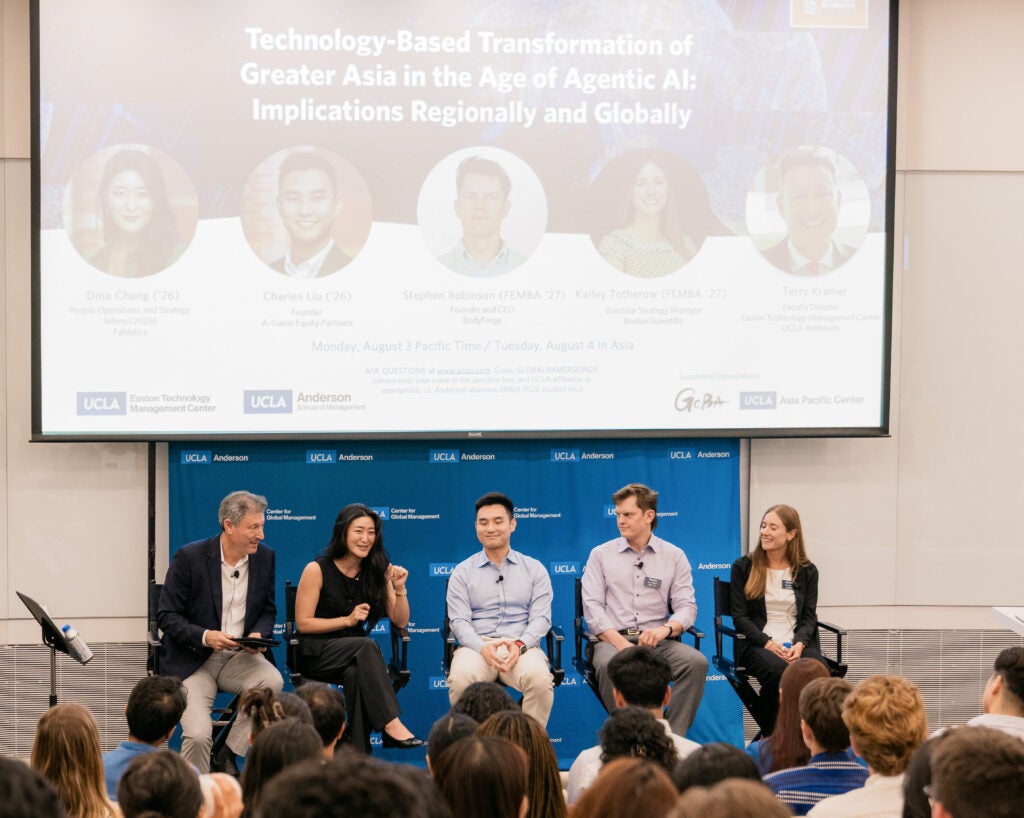
The panelists reflected on lessons learned during the immersion and their implications for business leaders operating in an increasingly AI-driven world. Discussion themes included the emergence of the “Agent Economy,” the growing role of AI agents in consumer and enterprise interactions, evolving business models, and the speed with which organizations are adapting products, services and workflows around artificial intelligence. Drawing on examples observed during the course, panelists discussed how AI-enabled innovation is transforming customer engagement, content creation, operations and decision-making, while also creating new expectations around agility, experimentation and organizational learning. They highlighted the rapid pace of technology adoption across Asia, the rise of AI-native business models and the increasingly important role of understanding local market context when evaluating innovation opportunities.
The discussion resonated strongly with attendees, many of whom are navigating their own academic and professional paths amid accelerating technological change. The panelists’ thoughtful reflections, candid insights and ability to connect their in-country experiences to broader leadership challenges provided valuable perspectives on the opportunities and responsibilities facing the next generation of leaders.
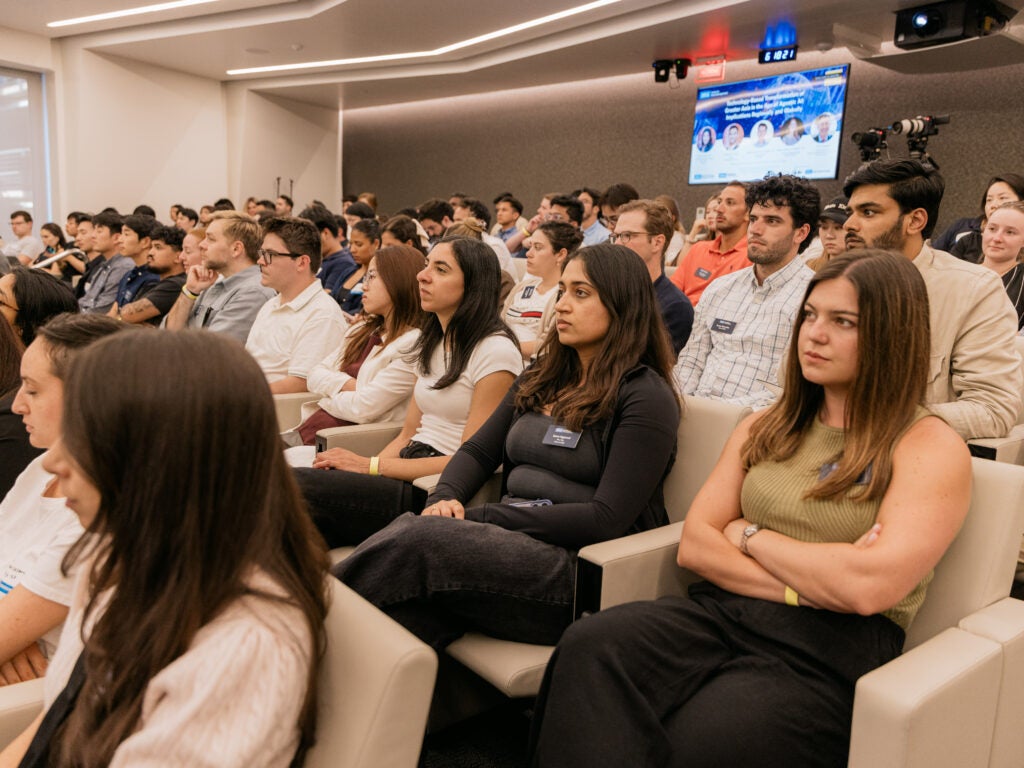
The event welcomed around 300 students and alumni with broad representation across UCLA Anderson’s degree programs, as well as faculty, staff and members of the broader UCLA and general community, joining both in-person and via livestream from around the world. A networking event preceded the discussion, offering in-person attendees the chance to connect across programs and cohorts and with locally based alumni who returned to their alma mater. The UCLA Anderson Greater China Business Association and the UCLA Asia Pacific Center served as supporting organizations.
Read more about the global immersion course’s in-country program here >>.
Watch the recording of the discussion.
About the Series
The Wilbur K. Woo Greater China Business Series engages leading executives, innovators, influencers, investors and academics in conversations around the major forces, trends and innovations in the region across society, enterprises and consumers. Through balanced discourse, the series serves as a neutral forum to exchange ideas and learnings, understand new norms and models, and provide forward-looking perspectives on advancements to better understand the trends, opportunities and challenges of doing business in and with the Greater China region.
Born in China in 1916, the late Wilbur K. Woo (B.A. ’42) received his bachelor’s degree in business administration from UCLA. He went on to become a major figure in Los Angeles business, political, cultural and charitable arenas, and was known for his decades of leadership in the Chinese American community. Global reach starts with global thinking, and over two decades ago — recognizing the rapid expansion and modernization of China’s economy — Woo, the vice chairman of Cathay Bank, and his wife, Beth, endowed the Wilbur K. Woo Greater China Business Conference at UCLA to show their gratitude for the training Wilbur had received at his alma mater. This conference has since evolved into the Wilbur K. Woo Greater China Business Series. The Woos’ goal was to facilitate dialogue, promote understanding and strengthen the important ties between the Greater China region and the United States, helping to to identify areas of collective opportunity, foster cooperation and bring leaders, both aspiring and established, together to collaborate and learn.
CGM sidebar
- Students Explore Profit, Purpose and Policy Through Sustainable Business, Climate Action and Corporate Strategy in Belgium and the Netherlands
- New Courses Continue to Expand Global Management Curriculum
- When a Capstone Becomes a Calling: Ankit Choudhary’s Journey from UCLA Anderson to Project Mercy
- Creating Global Impact in Rwanda and Ethiopia: UCLA Anderson’s Global Social Impact Consulting East Africa Capstone
- Developing a Business-to-Government Growth Strategy for a UK-Based Tandem App/Platform
- How Political Connections Distort Human Capital Investment and the Allocation of Talent Within Firms and Public Organizations
- Global Management Specialization Graduate Mick Morris (’26)
- Global Management Specialization Graduate: Marisa Lue (’26)
- Global Management Specialization Graduate: Aneesha Kumar (’26)
- CGM Welcomes International Exchange Students to UCLA Anderson for a Week of Global Learning and Networking
- Congratulating the Class of 2026 Outstanding Students in Global Management and Leadership
- Building Community with Globally Minded UCLA Anderson Alumni
- Students Explore Technology, AI and Innovation in Shenzhen and Singapore
- Students Travel to Paris and Bordeaux to Explore France’s Diversified Economy, Global Brands and Role in the European Union
Follow Us


