

Students and Alumni Travel to São Paulo and Rio de Janeiro for a Perspective on Brazil’s Business Landscape and Opportunities and Challenges in Latin America’s Largest Economy
Sunday, December 14 – Saturday, December 20, 2025
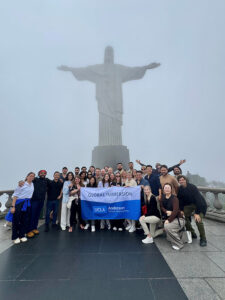
During winter break, 34 UCLA Anderson students and alumni from across programs traveled to São Paulo and Rio de Janeiro to examine Brazil’s dynamic economy, innovation ecosystem, and leadership context across consumer goods, health tech, venture capital, energy, infrastructure, mobile communications and live entertainment. This experience was part of the Center for Global Management’s Global Immersion course, titled “Navigating Brazil’s Business Landscape: Opportunities and Challenges in Latin America’s Largest Economy,” led by Eric Sussman, adjunct professor of accounting and real estate. This marked the sixth time that a Global Immersion course focused on Brazil. The CGM last visited São Paulo and Rio de Janeiro in 2018. The course combined company visits, executive dialogues, alumni engagement, and cultural experiences to illuminate how purpose-driven leadership, technological change and operational excellence shape outcomes in Latin America’s largest consumer market.
As the fifth largest consumer market in the world with a population of some 220 million, a democratic political system and abundant natural resources, Brazil offers a compelling opportunity for business and investment. In the last several decades, Brazil’s economy has experienced significant growth, while addressing some of its ongoing challenges: wealth inequality, corruption, political instability, inadequate infrastructure, violent crime in its cities, and challenges attracting and retaining foreign capital and investment due to its complex regulatory and tax policy. The course addressed opposing viewpoints and dichotomies, via pre-travel class lectures and the immersive week in Brazil where students examined and evaluated this fascinating country, one that has grown and changed substantially since the end of military rule in the mid-1980’s. There was much to be studied and much to be learned.

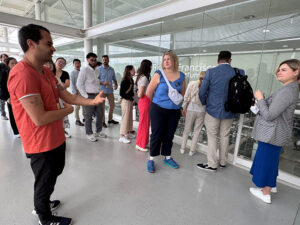
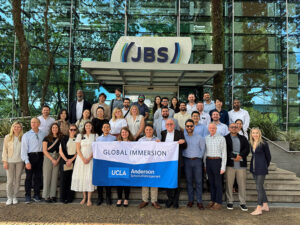
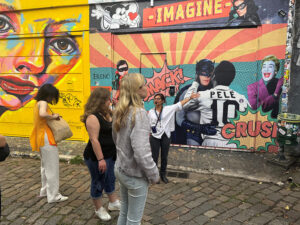
The immersion centered on the interplay between macroeconomic forces, sector-specific strategies and contextual leadership. In São Paulo, students explored how established multinationals and high-growth ventures navigate complex regulatory and supply-chain environments while scaling innovation and sustainability agendas. In Rio de Janeiro, discussions highlighted energy transition, digital connectivity and the creative industries’ role in urban revitalization. Together, these experiences fostered comparative insights on business model adaptation, stakeholder management, and ESG integration within Brazil’s evolving landscape.
The program began in São Paulo with a contextual city tour that framed Brazil’s commercial capital as a complex, fast-moving environment where policy, finance and industry intersect. A macroeconomic briefing from Sérgio Goldbaum, Professor and Economist from Fundação Getulio Vargas (FGV) provided a structured overview of growth drivers, inflation dynamics, regulatory considerations, and the practical realities of doing business in Brazil – grounding subsequent conversations in first-principles economics and institutional context.
Students then shifted to leadership lessons from the consumer goods sector, drawing on experiences from Unilever Brazil to understand category strategy, brand stewardship and the operational discipline required to serve a diverse, price-sensitive market at scale. The discussion examined the Brazilian context and consumer behavior, highlighting what the market teaches us about leadership in complex environments.
A session with Mindset Ventures focused on Brazil’s venture capital landscape and the financing of fintech innovation. Mindset Ventures, an early-stage venture capital firm based in São Paulo, invests in B2B technology startups across sectors such as fintech, agriculture, healthcare, cybersecurity and education. Students learned how fintech dominates venture capital investments across Latin America and how cross-border networks connect Brazilian capital with startups in the United States and Israel, enabling those companies to scale and expand into the Brazilian market. The conversation underscored rigorous due diligence, portfolio value creation, and the importance of timing and regulatory fit when scaling financial services ventures.
The class visited JBS, one of the world’s largest protein companies headquartered in São Paulo. Here, the dialogue focused on food production and distribution, innovation in processing and logistics, and the sustainability imperatives inherent to operating at global scale. Students examined stakeholder expectations across markets, the complexities of supply chains spanning five continents, and the governance structures that support investor relations and long-horizon strategy. Jerry O’Callaghan, Chairman of the Board of Directors, also shared his personal journey and career trajectory, illustrating how JBS grew from modest origins to become the largest meat and protein producer in the world, with a diversified portfolio spanning multiple continents and product lines.
The following day, a visit to Natura’s manufacturing operations connected purpose-driven strategy with product innovation and Amazon-sourced ingredients. The plant tour showcased operational excellence and circularity principles, while briefings explored brand building, international growth, and a values-led approach to biodiversity and fair-trade partnerships. The session reinforced how sustainability can be embedded into both design and execution.
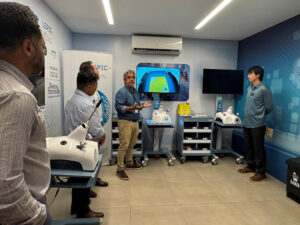
At Hub InovaHC – Hospital das Clínicas’ innovation center – students engaged with leaders and founders advancing health tech, value-based care and translational research. The tour and discussions provided a window into Brazil’s hospital innovation ecosystem, including startup collaborations, lab infrastructure, and the data and workflow changes required to scale patient-centric solutions.
Midweek sessions examined Brazil’s commercial real estate market with Colliers, and then shifted to São Paulo’s vibrant startup community with Itaú Cubo and local entrepreneurs. Founders from Nuvemshop, Sororitê and Bar Over Bottles (B.O.B.) shared insights on product-market fit, e-commerce, capital formation, environmental responsibility, and inclusive innovation. The discussions concluded with a networking lunch that deepened connections between students and Brazil’s venture ecosystem.
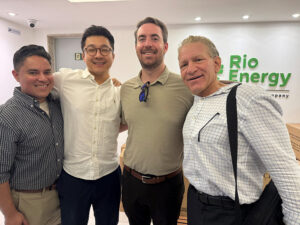
The class transferred to Rio de Janeiro, where a discussion on innovation, AI, and the entrepreneurial mindset framed the city’s digital opportunities and design-led problem solving. Conversations at Rio Energy explored the growth of wind and solar assets, project finance, and ESG practices shaping Brazil’s clean-energy matrix. A briefing from Porto do Açu examined ports, logistics, and supply-chain infrastructure – highlighting how industrial connectivity enables regional development and export competitiveness.
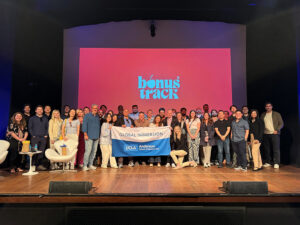
A session at TIM Brasil provided a market overview of mobile communications, including network investments in 4G, 5G, and fiber, and the strategic execution required to expand digital inclusion while maintaining service quality and efficiency. The cohort also met with Luiz Oscar Niemeyer, President and Chief Executive Officer, and his daughter Luiza Niemeyer (’19), Chief Financial Officer of Bonus Track Entertainment, to hear how live events, venue operations and creative production can catalyze urban economic activity and brand experiences – offering a distinctive lens on leadership across the arts and commerce.
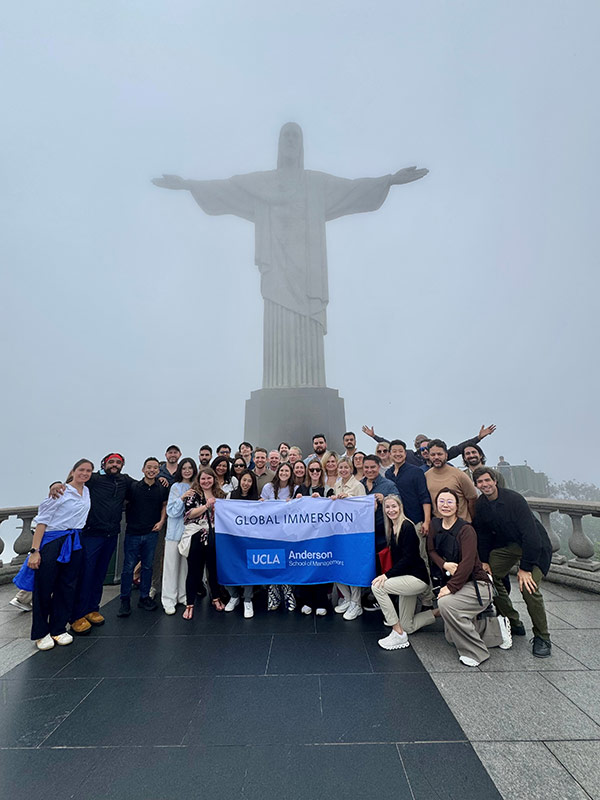
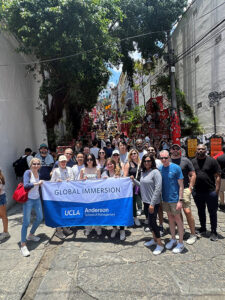
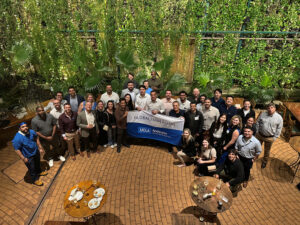
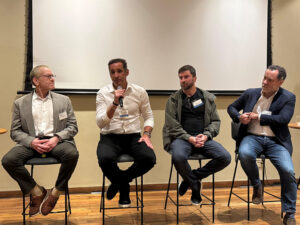
An alumni panel and networking event in São Paulo brought together Anderson graduates from Disney, Rede D’Or, and São Pedro Capital to discuss opportunities and challenges in Brazil’s business landscape. Renato D’Angelo (’09), General Manager Brazil and Head of Marketing OOH LATAM at The Walt Disney Company, joined Ariel Dascal (’00), Chief Digital Officer at Rede D’Or Sao Luiz and former Brazil Alumni Chapter President, and Alex Dias (’00), Founding Partner at São Pedro Capital, for a moderated conversation with Professor Sussman. The panelists shared their career journeys since graduating from Anderson and discussed key industry trends, highlighting leadership agility, stakeholder engagement, and cross-sector collaboration – underscoring the strength of Anderson’s global network. Cultural experiences in both cities – including city highlights tours, a visit to Christ the Redeemer, neighborhood walks, and local cuisine – provided valuable context for understanding consumer behavior, urban dynamics, and the everyday realities that influence market demand.
Collectively, the Brazil Global Immersion explored the country’s unique story – its progress, paradoxes, and potential. The week offered a rich, multi-sector perspective on how strategy, innovation, and values converge in an economy marked by resilience and reinvention. It also highlighted how sustainability and inclusion have become competitive capabilities – not just compliance – when embedded in product design, supply chains and capital allocation. Students gained insights into key industries and sectors critical to Brazil’s growth. Through executive engagements, plant and lab tours, and cultural immersion, they deepened their understanding of contextual leadership: how company strategy in Brazil is inseparable from institutional dynamics, regulatory processes and infrastructure realities; how leadership benefits from balancing operational rigor with empathy for local stakeholders and a long-term view of value creation; and how cross-border networks – linking venture investors, multinationals and founders – accelerate learning cycles and scale, making Brazil a dynamic and evolving business environment.
CGM sidebar
- Students Explore Profit, Purpose and Policy Through Sustainable Business, Climate Action and Corporate Strategy in Belgium and the Netherlands
- New Courses Continue to Expand Global Management Curriculum
- When a Capstone Becomes a Calling: Ankit Choudhary’s Journey from UCLA Anderson to Project Mercy
- Creating Global Impact in Rwanda and Ethiopia: UCLA Anderson’s Global Social Impact Consulting East Africa Capstone
- Developing a Business-to-Government Growth Strategy for a UK-Based Tandem App/Platform
- How Political Connections Distort Human Capital Investment and the Allocation of Talent Within Firms and Public Organizations
- Global Management Specialization Graduate Mick Morris (’26)
- Global Management Specialization Graduate: Marisa Lue (’26)
- Global Management Specialization Graduate: Aneesha Kumar (’26)
- CGM Welcomes International Exchange Students to UCLA Anderson for a Week of Global Learning and Networking
- Technology-Based Transformation of Greater Asia in the Age of Agentic AI
- Congratulating the Class of 2026 Outstanding Students in Global Management and Leadership
- Building Community with Globally Minded UCLA Anderson Alumni
- Students Explore Technology, AI and Innovation in Shenzhen and Singapore
- Students Travel to Paris and Bordeaux to Explore France’s Diversified Economy, Global Brands and Role in the European Union
Follow Us


